




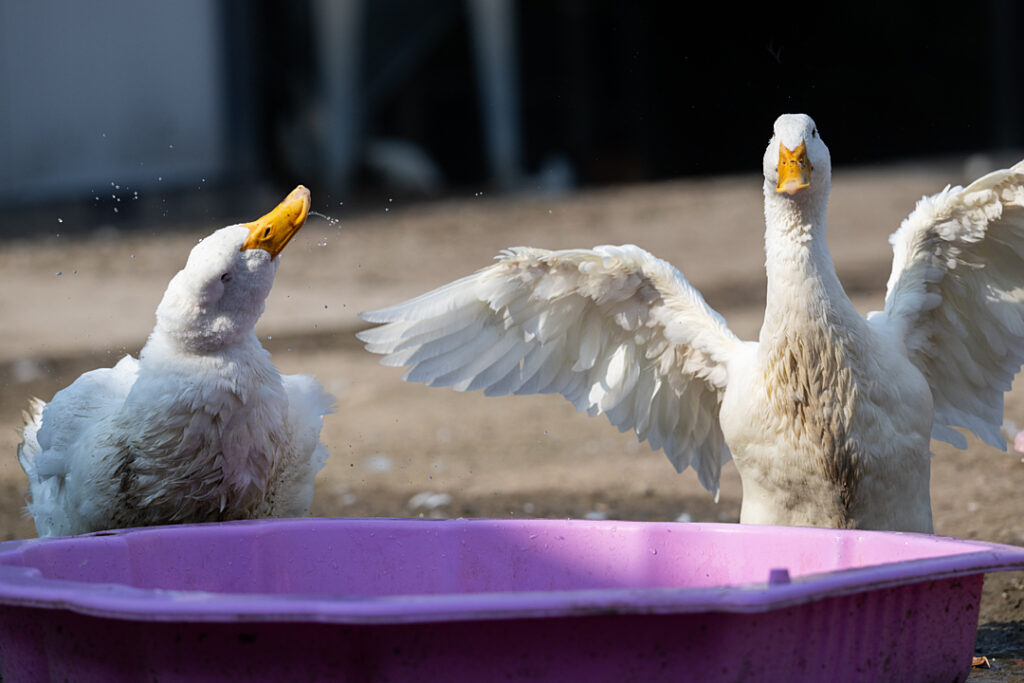
DucksUnless explicitly mentioned, we are referring to domesticated duck breeds, not wild ducks, who may have unique needs not covered by this resource. are social animals who naturally live in flocks with other ducks. Even though they will typically do best living alongside other ducks, it’s important to plan and conduct duckUnless explicitly mentioned, we are referring to domesticated duck breeds, not wild ducks, who may have unique needs not covered by this resource. introductions thoughtfully to ensure the safety and well-being of your residents! Below, we’ll talk about important things to keep in mind when preparing for and conducting duck introductions.
Planning For Duck Introductions
Consider Letting Ducklings Grow Up A Bit
If you are considering introducing a duckling to a flock of mature ducks, it’s important to think carefully about when it is best to do so. The age at which you slowly start introducing ducklingsYoung ducks to the flock will be dependent on personalities, nutritional needs, flock arrangements, and your physical setup. In most cases, you should wait until they are at least 6 weeks old, though some caregivers prefer to wait quite a bit longer.
Of particular note, be sure to think about whether or not you will be able to continue to meet the duckling’s nutritional and environmental needs if they move in with your flock. Also, remember that ducklings are more vulnerable to predation than mature ducks (though mature ducks are also vulnerable to predation). Depending on your setup, you may need to make modifications to make the space safe for ducklings.
We’ll talk more about the challenges of springtime introductions below, but keep in mind that drakes (male ducks) may behave more territorially in the spring and may be too rough at this point for young ducklings.
Consider Their Sex And The Make-up Of Your Flock(s)
Before conducting a duck introduction, it’s very important to think about the sex of the individuals involved. Male and female ducks can safely live together, generally, but depending on your resident population, you may find that it’s best to house males separately from females. Though not all females are going to get along, it’s typically easier to introduce a female to other females or into a mixed-sex flock than to conduct introductions involving males. That’s not to say male-to-male introductions can’t be done – they just may take a little more time and benefit from a bit more planning.
If you are considering introducing a new male into a mixed-sex flock, you not only have to consider if the males will get along (as well as the new male and the females in the group), but you also need to consider how his introduction will affect the male-to-female make-up of the flock. A ratio of one drake per four females is often recommended and can be used as a starting point, but as with so many other things, there really isn’t a magic ratio that is guaranteed to work every time. That said, when it comes to introducing another male to a mixed-sex flock, the lower the ratio of males to females, the better. While you typically want to ensure there are more females than males in each flock, there have been instances of male/female pairs living together safely. Some males may be far too enthusiastic to live with just one female, but it’s something to consider for more mild-mannered males.
When considering an introduction that involves males and females, it’s also important to consider each individual’s size. It’s safest to avoid housing female ducks with drakes who are significantly bigger than them to reduce the risk of injuries associated with mounting.
Consider The Season
Springtime hormones can have a major impact on flock dynamics, and therefore, spring may not be the best time to conduct certain introductions. Males may be overly enthusiastic about mounting females, complicating introductions involving males and females. Springtime hormones plus the excitement of an introduction could result in repetitive and or overly rough mounting, putting females at risk of injury and creating a stressful living environment.
Hormones also play a major role in tensions between males. As a result, springtime introductions between males could result in more confrontationalBehaviors such as chasing, cornering, biting, kicking, problematic mounting, or otherwise engaging in consistent behavior that may cause mental or physical discomfort or injury to another individual, or using these behaviors to block an individual's access to resources such as food, water, shade, shelter, or other residents. behaviors than would have occurred at a different time of year. Though it may be complicated or inconvenient to avoid a springtime introduction, in all likelihood, the introduction will go much better if you can wait for hormone levels to come down a bit.
Conducting Duck Introductions
Once you’ve done all your prep work and are ready to conduct the introduction, you might opt to start by housing ducks who are going to be introduced to each other in separate but adjacent spaces before fully integrating them (as described in Preparing For And Conducting Resident Introductions). If your physical infrastructure does not allow for this, consider setting up a temporary “integration kennel” in or adjacent to the resident flock’s living spaceThe indoor or outdoor area where an animal resident lives, eats, and rests.. You can use an exercise pen, large kennel, or something similar to create a safe, enclosed space for the new individual where they can see and communicate with the other duck(s) without coming into physical contact with them. Be sure to avoid anything with gaps large enough for individuals to fit their heads through and avoid anything with sharp edges that could result in injury.
The new resident can spend time in this transition space during the day and then move back to their own space in the evening (remember all ducks need to be in a safe, predator-proof space overnight). Make sure the integration space has everything they need to be comfortable – food, water (both for drinking and swimming/splashing, if the weather allows), plenty of space, a nesting area (if applicable), and shade. When using an integration kennel outdoors, be sure to consider how a resident will be impacted by weather conditions, and avoid situations where they will be stuck out in uncomfortable conditions.
If opting for the separate but adjacent method, be sure to observe interactions closely to ensure this is a safe and appropriate setup. If individuals appear stressed, are overexerting themselves, or are at risk of injury from trying to fight through the shared barrier, you’ll need to pause the introduction and regroup.
Once you’re ready to allow the ducks to be in a shared space with each other, it’s very important to closely monitor everyone’s reaction. For ducks other than Muscovies, positive signs include individuals approaching each other (without nipping) and bobbing their heads up and down. Muscovies will often approach other Muscovies and repeatedly extend their neck while talking back and forth with one another. A little bit of nipping, chasing, and mounting is not uncommon as everyone figures out their place in the social hierarchy, but as long as no one is overdoing it or at risk of being injured, it’s generally best to let them sort things out for themselves (while you closely observe the situation). However, if things get out of hand, you’ll need to break up conflicts quickly.
While some pecking, chasing, and mounting is not unusual, intervention may be necessary if these behaviors are prolonged and/or excessive or if confrontations escalate to involve kicking and wing slapping. Additionally, be sure to intervene if an individual pins someone by the neck or if multiple individuals are ganging up on someone. Keep in mind that while a large water source, such as a pond, is ideal for ducks, altercations or overly enthusiastic mounting can be much more dangerous on the water and will make intervening more difficult. Sadly, there have been reports of female ducks drowning while being mounted on the water, so it may be best to restrict your residents’ access to large open water sources until you have had a chance to see how the introduction goes.
In addition to watching for physical contact that could result in injury, be sure to watch closely that residents are not exhausting themselves or showing signs of overheating. In some cases, you may need to separate individuals and try again later (or consider a different option entirely). Also, be sure to observe your residents’ body language and general interactions. Even if there is no physical altercation, if one or more individuals appear to be very intimidated by someone else in the group, this may not be a healthy living arrangement for them. While individuals may settle in over time, if residents are constantly stressed and/or unable to engage freely in normal activities (for example, if they are constantly hiding or bullied away from food), they should be provided a different living arrangement.
Even if things appear to be going well, be sure to provide lots of supervision throughout the day (and in the coming days) to ensure everyone is getting along. Some situations that arise during the day may result in more tension than others, so ongoing supervision is key! Just because everyone is getting along well in their outdoor living space soon after the new resident arrives, it does not mean that there will not be an altercation later on.
Things To Keep In Mind After Conducting Duck Introductions
Once you’re confident that everyone is settled in and is safe to stay together without constant supervision, there are still important things to keep in mind as everyone adjusts to their new living arrangements.
Make Sure Everyone Has Easy Access To Resources
It’s important to watch closely to ensure that everyone in the group continues to have easy access to resources such as food and water and that they can easily seek shelter if they so choose. A quick peek in on the group may reveal no obvious tension, but upon further observation, you may notice that someone is too nervous to go inside when others are in there or that they are being chased away when they try to go for a swim. As mentioned above, the absence of a physical confrontation is not necessarily indicative of healthy group dynamics, so be sure to watch closely for signs of tension or distress. In some cases, offering additional resources and making sure those are spread out may alleviate tensions. For example, adding a couple of extra kiddie pools to the space may make it easier for everyone to take a dip while steering clear of individuals who intimidate them.
Overnight Accommodations
Sometimes newly introduced duck residents will get along just fine during the day when they have more room to spread out and avoid each other, but will show signs of discord when closed in overnight. Pay close attention to how everyone behaves after being closed in for the night – if the new resident appears anxious or other residents start pecking at them, offer the new duck(s) a separate sleeping space (preferably within or adjoining the flock’s living space, if possible).
Watch For Signs Of Overmounting
Mounting is a normal duck behavior, but females can be injured if they are mounted excessively. Feather damage on the top of the head and/or back of the neck is a telltale sign that someone is being overmounted. This can become so severe that the area ends up bald and scabbed. While this in and of itself is painful, overmounting can also result in more serious injuries, so if you see someone has damaged feathers on their neck, observe closely to see what’s going on. You may need to make temporary or permanent changes to the living situation to prevent further injury and ensure healthy flock dynamics.
While following the guidance above (and the guidance contained in Preparing For And Conducting Resident Introductions) can help set you up for success, it’s important to remember that every individual and situation is unique. Some introductions may take more time than others, and some residents may simply never get along, so it’s always a good idea to have a plan B in mind!