



This resource was fully reviewed and updatedA member of The Open Sanctuary Project’s staff has given this resource a full review and provided updates where necessary. by a member of The Open Sanctuary Project’s staff as of August 3, 2026. It was originally published on August 14, 2018.
If you’re caring for geeseUnless explicitly mentioned, we are referring to domesticated goose breeds, not wild geese, who may have unique needs not covered by this resource., you must know how to gently handle and restrain them. Gentle handling and restraint can be necessary for a variety of care-related tasks, but it should always be approached thoughtfully. Situations that may require gentle handling and restraint include performing health checks, closely evaluating an individual showing signs of concern, administering medications, or responding to an emergency.
Some geese are more tolerant of restraint and handling than others. While some of this may come down to individual personalities and preferences, an individual’s size, health, and socialization also factor in. You may find that some residents require modifications to your typical handling and restraint technique to ensure their comfort and safety.
The Approach
Before you can restrain a gooseUnless explicitly mentioned, we are referring to domesticated goose breeds, not wild geese, who may have unique needs not covered by this resource. resident, you must be able to get close enough to touch them. Depending on the individual and the circumstances, this may or may not be an easy task. Some residents may come over to you on their own (especially if enticed with the prospect of loving petsAnimals who spend regular time with humans in their home and life for companionship or human pleasure. Typically a small subset of animal species are considered to be pets by the general public. or a few tasty treats), and others may be comfortable with you approaching them. However, some residents may prefer to keep their distance from humans, in which case you’ll need to approach them thoughtfully. When approaching a goose, do not chase them! Geese are prey animals, and chasing them is going to stress them out. Not only this, but residents will remember a negative experience, which could make them more fearful or agitated when faced with a similar situation, potentially making it harder to approach and restrain them in the future.
If you need to approach a goose resident who prefers to keep their distance (and therefore moves away from you when you approach them), you’ll need to use elements of the space to calmly corner them. If you are attempting to do this in a large, wide-open space, you may need to get another person (or a few other people) to help you. Generally speaking, if you can first guide them into a smaller, more contained space, it will be easier to approach them. For example, if they are in a large outdoor space and their indoor space is smaller, you might start by encouraging them to go inside.
Encouraging one individual to move where you want them to go is usually more difficult than encouraging a group to do so. Therefore, you’ll typically need to encourage the entire flock, or at least part of the flock, to move indoors rather than trying to get just one resident to do so. When attempting to move only part of the flock, be sure to include the individual’s partner or closest companion in the group of individuals being moved. Attempting to separate them will not only cause the individuals stress but will also likely make moving them more difficult. If residents have access to a pond, you might want to block it off, if you can, to prevent them from accessing it while you are trying to encourage them to move. Depending on the size of the pond, it can be quite tricky to encourage a goose resident to get out of the pond if they don’t want to!
Geese are startled by sudden movements and loud noises, so when encouraging them to move, you’ll want to move slowly and calmly and avoid loud sounds like shouting. You can encourage them to move in the direction you want them to go by extending your arms out to the side and guiding them in that direction. You can crouch down slightly when doing this, but you always want to make sure you keep your face out of biting range, so be careful about bending down too low, especially when working around geese who have a tendency to bite! The more people you have helping, the easier it is to encourage geese to move in a specific direction. If you don’t have a helper, you can use elements of the living spaceThe indoor or outdoor area where an animal resident lives, eats, and rests. to help guide them (such as walking them along a fence line rather than through the middle of an outdoor space). Ultimately, you want to guide them into a corner or other confined space so that you can calmly approach them without them running away from you.
Gentle Handling And Restraint Options
Once they are in a more confined space and you’ve gotten close enough to touch them, you have a couple options. If you suspect they are going to try to move away from you, you can extend one arm in front of them, held at about the height of the base of their neck, which will prevent them from moving forward. With a bitey individual, this arm will most likely be bitten, but it will also keep their bill busy while you get a firm grasp on them – as mentioned above, a thick, long-sleeved shirt can protect your skin, and it’s much better to be bitten on a clothed arm than on your face! With the individual prevented from moving forward, you can work on picking them up.
One way to do this while ensuring you can keep your face out of their biting range is to place one hand on either side of their body near the top of their wings. Hold them so that their wings are held firmly against their body, which will prevent them from flapping and hurting themselves (or you). Placing your hands further back on their wings could allow them to get a wing free. With both hands in place, you can keep your arms extended so that there is a safe amount of distance between them and you. For some individuals, this may not be necessary, but if you are unsure if they are likely to bite, it’s best to play it safe.
Once you have them firmly in your grasp, you have a few options, and different techniques will work better in different situations depending on factors such as the purpose of restraint, resident health and preference, caregiver capability and preference, and how many humans are on hand to assist. In general, it’s a good idea to be comfortable using a few different restraint options. This way, you’ll be able to use the most appropriate option based on the circumstances. When considering which restraint option will be best in any given situation, it can be helpful to consider the following:
- How much restraint is necessary to safely perform the task at hand?
- Do I know which form of restraint this individual is usually most comfortable with?
- Does this individual have health issues that make certain restraint options inadvisable?
- What would be the least stressful form of restraint in this situation? (Consider the individual, the task at hand, etc.)
As you may have guessed from these questions, the most appropriate form of restraint for one resident may not be the best one for another. Additionally, even when considering restraint for the same individual, what is most appropriate when performing one task may not be best in a different situation. For example, you may opt for a restraint method that keeps the individual standing on the ground when administering medications, but you may find it’s easier to have them in your lap if you need to trim that same resident’s nails.
Up next, we’ll discuss a few different restraint methods that can be helpful to learn when working with geese.
Picking Up And Setting Down A Goose
When picking up a goose, you want to make sure their wings are fully contained so they are not able to flap them. Not only could flapping their wings while being held result in injury to their wings, but it could also result in injury to you if you are smacked with their strong wings. With smaller geese, you should be able to position your hands so that they are holding the goose’s wings against their body while also having a firm grip on their body. You should never pick a goose up by their wings! When you are certain you have a good hold on the individual and can keep their wings safely contained, you can then lift them off the ground.
If you are unable to maintain a firm grip on their body while holding their wings in place, which may be the case with larger geese, you can reach one arm over their back and wrap it around them so your arm is holding their wing in place and your hand is underneath their body supporting their weight. This arm will do most of the lifting, and you can use your other hand to hold their other wing against their body. This method will make it difficult to keep your face out of biting range, so you may need to use your non-scooping hand to keep them away from your face, or you may need to have a helper ensure you don’t get bitten.
After picking up a goose, you can utilize one of the restraint methods described below. When setting a goose resident down, always make sure their feet are firmly on the ground before letting go of them. Never let a goose jump from your arms or lap, and never drop them because this can lead to serious injury.
Holding A Goose In Your Arms
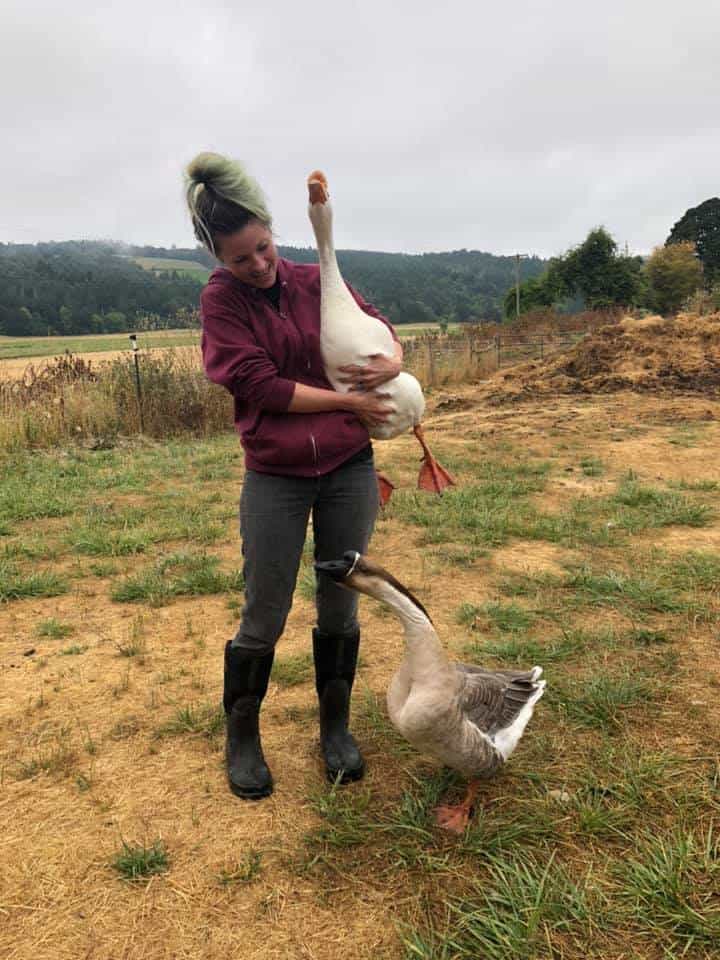
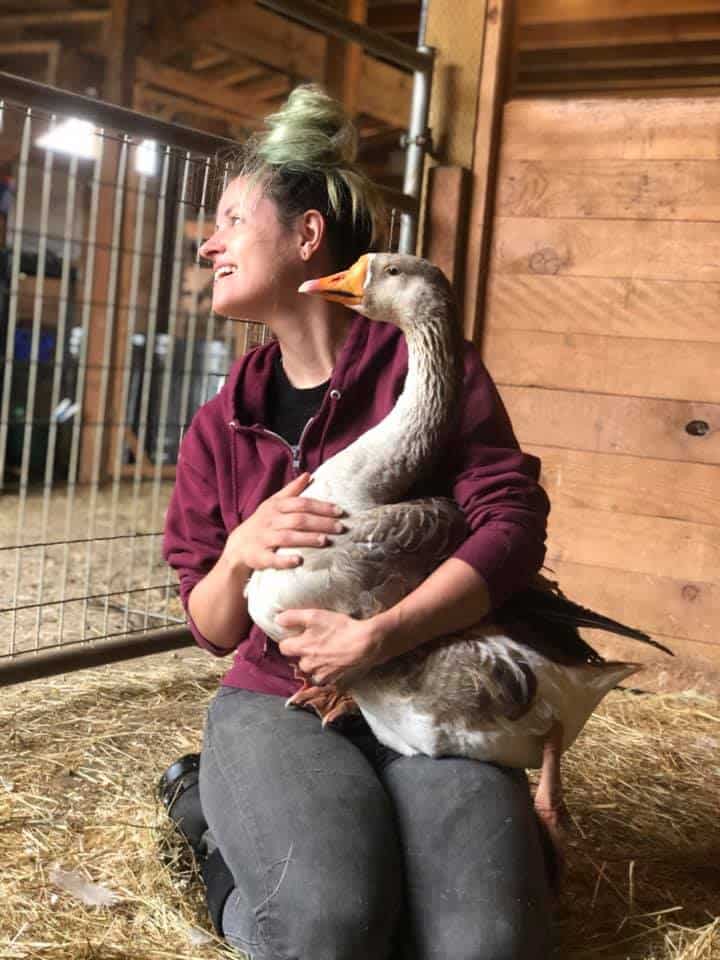
To hold a goose in your arms, which may be necessary to carry them to a new location or to restrain them for certain care tasks, bring the goose towards you and hold one side firmly against your body. You can hold them against the front of your body or against the side of your body (see image above), wrapping your arm around them so your hand is under their sternum. This arm will do most, if not all, of the restraint. One wing will be held in place by your body, and the other wing will be held in place by the arm you are holding them with, thereby freeing up your other hand. This hand can be used to protect from bites (as described above), or you can use your free hand to offer more support to their keel, to gently stroke their feathers, or to perform a task that only requires one hand. Holding a goose in your arms like this also works well if you need to hold them while someone else performs certain care tasks. If you do not have a helper and need to restrain them while also performing a task that requires use of both hands, you’ll want to opt for a different method.
When holding a goose, be prepared to put them down if they start to struggle or if they get a wing free. This will prevent them from injuring their wing or jumping away from you, which can also result in injury. Additionally, be sure to pay attention to the individual’s breathing and general demeanor. Individuals with certain health challenges may show signs of respiratory distress (open-mouth breathing, cyanosis) when lifted off the ground and held in the way described above. For these individuals, you will need to find a different way to restrain them, such as having them upright in your lap or gently restrained while they remain standing on the ground.
Holding A Goose In Your Lap
Another restraint method that can come in handy is holding the individual in your lap. This is especially helpful if you need both your hands free (such as when trimming their nails). Similar to what is described above, when you lift them into your lap, you want to make sure their wings are held firmly against their body to prevent injury. While it’s possible to have the individual stand on your legs while you hold their wings against their body, other positioning will allow you to have one or both hands free and may do a better job of keeping them secure. One option is to lie them on your lap so their sternum is on your thighs and their legs dangle on the outside of your leg. This position will allow them to remain upright and may be best for anyone with health challenges that make them less tolerant of restraint. Some individuals will tolerate this position just fine, but others may kick their legs, trying to get them underneath them so they can stand. If this is the case, another restraint option may be best.
If they are okay with being tilted on their side, you can rotate them slightly when holding them in your lap, but be sure to watch for signs of respiratory distress and set them down if noted. You can see an example of this restraint method used with a duckUnless explicitly mentioned, we are referring to domesticated duck breeds, not wild ducks, who may have unique needs not covered by this resource. here. (If you have good pictures of a goose restrained in this way and would like to share them with us, please get in touch!)
Standing Restraint
For situations that do not require much restraint or where you have two people involved and one can focus solely on restraint, you might opt to restrain the resident while they remain standing. While this method may not always be appropriate, it can often be the least stressful way to restrain certain individuals and may be best for individuals who are less tolerant of other forms of restraint. To restrain an individual while they remain standing on the ground, you can kneel next to them and hold them in place with your hands firmly over their wings and body, or pull them against your body and restrain them with one arm while their feet remain firmly on the ground.
SOURCES:
Avian Respiratory System | University Of Kentucky
Catching & Handling Waterfowl | Majestic Waterfowl