



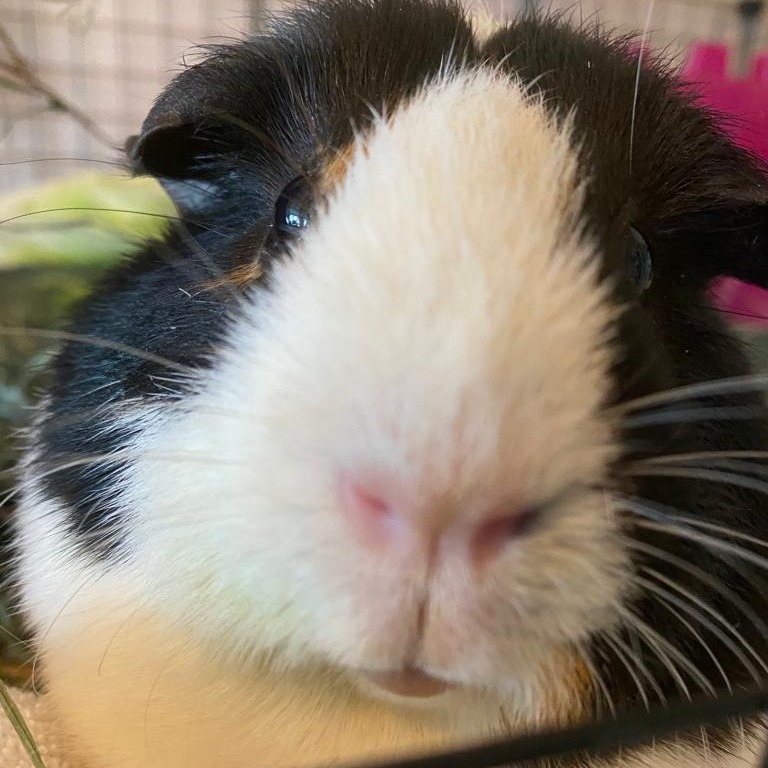
Like other residents, cavies need housing that will keep them safe and comfortable. Though one caregiver’s cavy living spaceThe indoor or outdoor area where an animal resident lives, eats, and rests. might look quite different from another’s, there are some important things to keep in mind in order to give cavies the best life possible. In addition to the considerations described below, we recommend checking out our resource on animal-centered design to get further inspiration for cavy resident housing!
Indoor Living Spaces
Cavies have a very narrow temperature range in which they are comfortable. Therefore, in most climates, they will need to reside primarily indoors, in human dwellings or similarly constructed spaces that can maintain a safe temperature (i.e., insulated and temperature-controlled). Providing an indoor living space for cavies is often accomplished by setting up a thoughtfully designed enclosure* within a safe space in the caregiver’s home. Alternatively, you could consider designating an entire room of your home as your cavy residents’ living space, but you’ll need to take steps to ensure it is “cavy-proof” in order to keep them safe. While either can be appropriate, setting up your cavy companion’s living space in an area where you spend a good amount of time will allow for closer observation and more interactions with them.
When setting up a cavy resident’s indoor space, keep in mind that it must:
- Provide enough space for normal activity and healthy social dynamics
- Be able to maintain a safe temperature and provide proper ventilation year-round
- Provide opportunities to exhibit natural behaviors
- Provide robust protection from predators
- Protect cavies from potential safety hazards
Up next, we’ll look at some of the components and considerations for indoor living spaces.
Size
Cavies require ample floor space for daily activity and exercise, and, as mentioned above, most commercially available enclosures for cavies are far too small to accommodate a cavy’s needs. Some enclosures offer multiple levels to increase the size of the overall living area, and this may be adequate for climbing species, but it is not appropriate for cavies. While some cavy residents may be able to safely utilize a low loft that is accessible via a wide, gently sloped ramp, when considering the space an enclosure provides, you should focus on the ground floor (we’ll touch on lofts and ramps more below).
Some cavy rescue groups recommend a bare minimum of about 7.5 square feet (6,968 square centimeters) of floor space per pair of cavies, but others require potential adopters to provide at least 10.5 square feet (9,755 square centimeters) per pair of cavies. Trios and larger groupings will require even more space and, as mentioned above, cuys will also need more space to accommodate their larger size. If you are housing two male cavies together, you also may need to offer additional space – some rescues recommend providing at least 12 square feet (11,148 square centimeters) of floor space for pairs of male cavies. When evaluating the space provided by ready-made enclosures, be aware that some designs have a tapered tray at the bottom, which often results in less floor space than the stated dimensions.
An appropriately sized living space will give you plenty of room to set up your cavy residents’ space with everything they need (such as hides, tunnels, and hay holders) while still leaving plenty of open floor space for activity.
Flooring And Bedding
Solid flooring is a must for cavies. Never house them on wire flooring, as this can cause pododermatitis (bumblefoot) as well as other foot or leg issues. When it comes to bedding, there are a variety of options that can be used with cavies. These include aspen wood shavings, paper-based bedding, or soft fleece atop a layer of absorbent fabric or pee pads. Never use cedar, raw pine, or other aromatic wood shavings in cavy living spaces. Some sources suggest that kiln-dried pine is acceptable, while others recommend steering clear of pine entirely.
Depending on your setup, you may decide that a combination of bedding is the best way to go. For example, if you opt for non-fleece bedding as the main bedding, you may still find it’s helpful to use fleece pads in their hides. You can then change these out daily without having to do a full bedding change. Similarly, if you opt for fleece as the main bedding, you may want to have a tray of aspen shavings or a paper-based bedding in the area where you provide hay (folks sometimes call this the “kitchen area”), which can also act as a sort of litter box.
Temperature Control And Ventilation
As mentioned above, cavies have a very narrow temperature range in which they are comfortable, making temperature control an essential aspect of their care. While their ideal temperature range is from 65-75°F (18-24°C), maintaining their living space between 60-80°F (16-26°C) is appropriate. In temperatures above 80°F (26°C), cavies can develop heat stroke, so it’s important to ensure you can keep spaces cooler than this when the weather is hot. Additionally, they do not do well in high humidity — you should aim to keep humidity levels between 40-70%. Never house cavies in aquariums, as they do not provide adequate ventilation, putting cavies at risk of various health issues.
Be sure to set up cavy living spaces in areas that are draft-free, consistently maintain an appropriate ambient temperature, and are away from direct sun. Avoid putting them near heat vents or other heat sources that could cause them to overheat. Consider setting up a thermometer on or next to their enclosure so you can monitor the ambient temperature and make adjustments as needed.
Hides
As prey animals, cavies have strong instincts to hide when they are resting or feel nervous. To help ensure their mental well-being, it’s important to provide them with hides (sometimes called hideys or hideouts). This can be accomplished by including covered houses, tunnels, or other covered areas in their living space. To ensure ample access, it’s best to provide at least one more hide than there are residents in the space (i.e., provide 3 hides for a pair of cavies). Because these covered areas may become soiled more quickly than the open floor space, you may want to use a different bedding that is more easily changed (some folks recommend using fleece pads in houses and to line tunnels or beds because these can be easily changed).
Predator-Proofing
While hides can help cavies feel safe from predators, you also have to make sure they actually are safe. Cavies are very vulnerable to predation from a number of species, so careful predator-proofing of their living spaces is a must. Housing cavies in your home can help ensure their safety from many of the predators they could encounter outdoors, but be aware that companion species such as cats and dogs can also pose a predation risk. While you may hear stories of dogs or cats getting along with (or ignoring) cavy companions, it’s important to understand that there have also been instances where cavies have been severely injured or even killed by dogs or cats. Even if a dog or cat is not actively trying to injure a cavy resident, please keep in mind that they could do so accidentally. Additionally, their presence alone may cause a cavy resident to feel stressed or unsafe.
If your cavy residents have an enclosure within a space dogs or cats also have access to, you should keep their enclosure covered and watch closely for signs that your cavy residents are distressed by the presence of the dog or cat. If noted, you’ll want to house your cavy residents in a space the dogs and cats do not have access to.
If cavy residents reside in a designated room within a dwelling where dogs and cats also reside, be sure to take steps to avoid them accidentally being able to get into the cavy room (perhaps by installing an additional latch on the door as a backup should the primary latch fail).
Protection From Safety Hazards
It’s not just predation that cavies need protection from. Their small size and chewing instincts can also put them at risk if appropriate steps are not taken to protect them. As mentioned above, C&C setups are a popular option with cavy caregivers, but even with these setups, care must be taken. Of particular note, you must pay attention to the size of the inner square openings before purchasing modular cube kits. Grids with openings larger than 1.5 inches (3.8 cm) pose a safety risk because cavies could get their head caught in the openings. That said, depending on the size and shape of an individual’s head, even 1.5-inch openings could pose a risk. Due to the risk of entrapment or escape, baby cavies less than a few months old should never be housed in enclosures with exposed grid openings (grids can be covered with coroplast or other materials to make them safe for babies or individuals with a narrow head).
If residents have access to an entire room, or if you provide time for your cavy companions to be out of their enclosure (often referred to as “floor time”), you’ll need to take additional steps to keep them safe. Electrical cords and other unsafe materials they could chew should be moved out of their reach. You also don’t want them chewing on any painted or stained wood surfaces (such as furniture or even baseboards). Electrical outlets they could reach should be covered.
It’s a good idea to block off spaces they could get into that would make them difficult to reach or find (under large pieces of furniture or in a cabinet, for example). When giving residents floor time, be sure to take steps to keep dogs, cats, and other potential threats away, and make sure any humans in the home are aware when cavy residents are out of their enclosure so they can take care when moving through the space.
Many substrates in human dwellings do not provide adequate traction, which could cause injury, especially if a cavy resident is startled and tries to run. Putting down fleece pads, carpet runners, or other materials that provide traction is recommended. Putting down washable pads and rugs also helps when it comes to cleanup. Cavies will pee and poop during floor time, so keeping surfaces covered with washable fabrics is a good idea even if traction is not a concern.
Outdoor Spaces For Cavies
As mentioned above, in most climates, cavies will need to live primarily indoors, but when the outdoor temperature and humidity fall within the appropriate range for cavies (60-80°F / 16-26°C, 40-70% humidity), they may enjoy supervised time outdoors in a protected area.
When designing an outdoor space for cavies to spend supervised time in when the weather allows, be sure to…
- Create a physical infrastructure that keeps residents safely contained and protected from predators
- Provide covered areas so residents can seek cover for a feeling of safety or to get out of direct sunlight
- Provide residents with enough space to move around freely
- Prevent access to treated grass and other safety hazards
Up next, we’ll take a closer look at some of these considerations.
Predator Protection In Outdoor Spaces
Even with supervision, you must ensure outdoor spaces for cavies keep them contained and prevent predators from accessing them. Predator attacks can happen quickly, and human supervision, while important, is not a replacement for infrastructure that protects them from predators. Be sure to check the space regularly (and ideally before each use) to ensure there are no potential breaches.
Covered Areas
In addition to physical protection from predators, be sure to include areas with solid, covered tops where cavies can go to feel safe or get out of direct sunlight. Houses and tunnels should be available outdoors, just as they are indoors (being sure to offer more of these spaces than there are cavies in the space).
Size
To ensure your cavy companions have ample room to stretch their legs and move freely (while still leaving room for covered areas and enrichment items), we recommend following the guidance for indoor spaces (described above).
Protection From Safety Hazards Outdoors
As with their indoor space, you must ensure cavy residents are protected from safety hazards while outdoors. Of particular note, make sure any grass or other vegetation they have access to has not been treated with fertilizer or chemicals and has not been contaminated with the urine or feces of other animals. To avoid issues with toxicity, err on the side of caution and only include plants in a cavy’s outdoor space that you have confirmed are safe for them. Exclude other potential hazards such as treated, painted, or stained wood they could chew.
Once you’ve got your cavy residents’ living space(s) set up, be sure to keep it clean and properly maintained to ensure their continued comfort, safety, and health!
SOURCES:
Adopting At The Los Angeles Guinea Pig Rescue | Los Angeles Guinea Pig Rescue
Guinea Pigs Of ECC | Empty Cages Collective
Guinea Pigs | Manual Of Exotic Pet Practice
Cuy Information | Wee Companions Small Animal Adoption
Guinea Pig Cages | Metropolitan Guinea Pig Rescue
Guinea Pig Housing | The Humane Society Of The United States
Skinny Pigs: What You Really Need To Know Before Buying Skinny Pigs | Los Angeles Guinea Pig Rescue
Guinea Pig Housing Requirements And Bedding Options | Humane World
Designing the Ultimate Guinea Pig Habitat | Long Island Bird And Exotic Veterinary Clinic
Guinea Pig Cage Guide | Southern California Guinea Pig Rescue
Cage & Cavy FAQs (Frequently Asked Questions) | Cagetopia
Outdoor Time For Small Pets: Benefits And Precautions | All Critters Veterinary Hospital