



As caregivers, it is important to deepen our understanding of how sanctuary residents experience the world. This understanding can help us provide more thoughtful, effective care for our residents. It is natural to use our own frame of reference and assume that residents perceive the world in the same way we do. This approach can be useful in fostering empathy on a general level and is important when considering the lives of nonhuman animals. For example, no one likes discomfort, and most of us have preferences for our favorite treats. But when it comes to the five senses—sight, sound, taste, touch, and smell—how individuals experience the world can differ significantly based on their general biology and individual variations. This is true for both human and nonhuman animals. For example, humans, as a species, can have 20/20 vision, yet how many people do you know who wear glasses? The same variation applies to equine residents. However, despite individual differences, there are general traits we can learn about that allow us to connect more meaningfully with our residents and, in turn, provide better care.
This article is part of a five-part series exploring how equines experience the world through their senses. Today, we’re focusing on vision. What can horses and donkeys and mules see? How does their vision differ from ours, and what does this means for the care we provide?
Ocular Insights: An Introduction
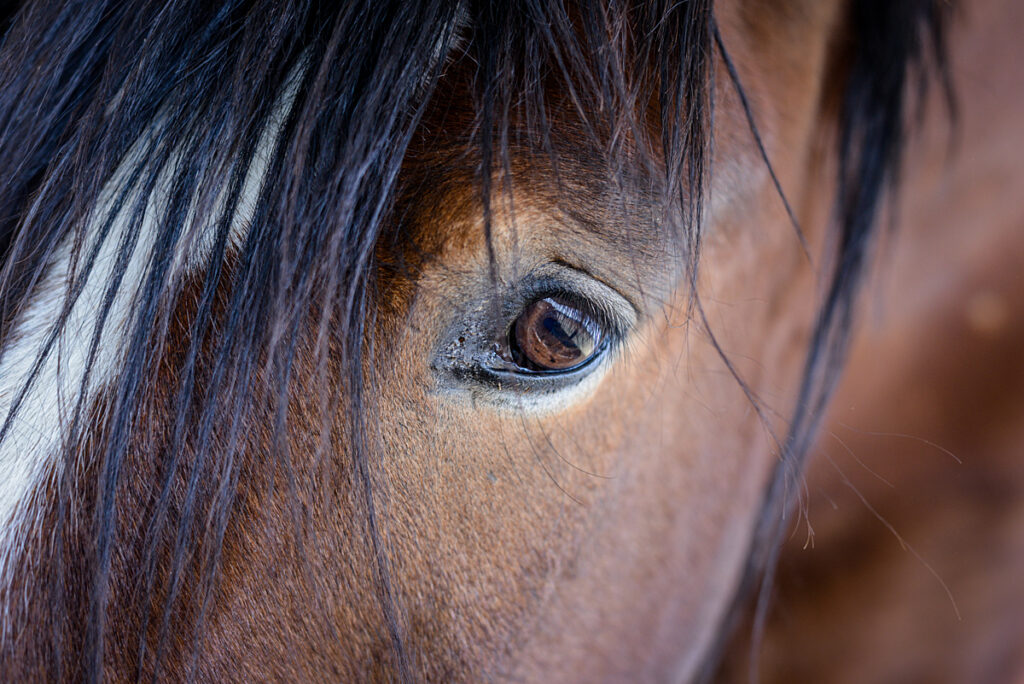
If you care for equine residents, no doubt you have found yourself gazing into someone’s beautiful big eyes. Equines have large, prominent eyes that give them a wide field of vision, helping them stay alert to predators while grazing. Their horizontal pupils and reflective tapetum lucidum enhance low-light vision, allowing them to see well at dawn, dusk, and in shaded areas. Because equine eyes are so prominent, they are prone to injury, making careful observation by caregivers essential to noticing subtle changes in eye health. Equine eyes, particularly horse eyes, can also provide health and emotional clues through body language. For more in-depth information about body language in horses, check out our “Understanding Horse Body Language: The Eyes” resource. To understand their world more fully, we first need to learn about the structures of their eyes and how those structures work.
A Peek Inside: Equine Eye Anatomy
Like our own eyes, equine eyes contain familiar structures such as pupils, lenses, and retinas. Yet there are important differences that shape how equines experience their surroundings. Their pupils are horizontal ovals, and they have a special reflective layer that boosts night vision. Together, these features affect not just what they can see, but how they interpret what they’re seeing.
By looking at the major parts of equine eyes, we can begin to understand both the strengths and limitations of their vision. Let’s break down some of the basic parts of the eye and how they function. For more indepth info on the anatomical structure of equine eyes, check out “Basic Horse Anatomy: The Eye“.
- Cornea: The cornea is the clear, outer surface of the eye. It is a clear, dome-shaped structure that protects the eye and lets in light. It assists in focusing light on the retina, which sits at the back of the eye. The sclera, the white of the eye, lay beneath the cornea, as do the iris and pupil.
- Sclera: The white portion of the eye, which provides structure and protection to other features of the eye.
- Iris: The colored part of the eye—typically a shade of brown but can also be light grey-blue or even green in certain breeds in rare cases. Sometimes one eye may be blue and the other brown. The iris regulates how much light enters the eye and is part of the uveal tract, which supplies blood to parts of the eye.
- Pupil: The pupil is the black horizontal oval area within the iris that enlarges or shrinks, in order to let in more or less light. If it is dark or nighttime, the pupil will enlarge to let more light in and if it is bright, the pupil will shrink to limit the amount of light.
- Lens: Located just behind the iris, the lens focuses light onto the retina. It changes shape depending on the distance of what the equine is looking at—becoming thicker for close objects and thinner for distant ones. This shape-shifting is controlled by the ciliary muscles (not shown in basic diagrams).
- Retina: The retina is the inner layer of the back of the eye, which contains millions of light-sensitive cells, cones, and rods, that transmit what a horse is seeing through the optic nerve and into the brain.
- Cones: Cone cells are responsible for vision in bright light and for detecting color. Humans have three cones, making us trichromatic (we see reds, greens, and blues). With two cones, equines are dichromatic—they see blues and yellows more readily, while reds and greens may blur together.
- Rods: Rods are one of two types of photoreceptors (light-sensitive cells that turn images into electrical impulses to be sent to the brain via the optic nerve). Rods are light-sensitive cells that allow sight in dimmer light.
- Tapetum Lucidum: The tapetum lucidum is reflective, located at the back of the eye, and helps improve vision in low light or at night. This is the structure responsible for when we see “glowing” eyes from certain animals in the dark.
- Corpora Nigra: Also called iridic granules, the corpora nigra is the irregular-looking areas of the iris dipping into the pupil. They may look a little like an inconsistent wavy pattern. They can also be seen at the bottom of the pupil in some horses. This structure is thought to help with glare from the light to help horses see better.
Now that we’ve learned about a basic equine eye structures and their purposes, let’s jump into the world of equine vision!
An Impressive View
Once we understand the parts of the eye, we can better learn how our equine residents “view” the world. With large eyes on the sides but also somewhat frontally located on their heads, equines have a nearly spherical view of the world around them when their heads are held level! This is truly incredible and important for caregivers to know when considering how equine residents perceive the world around them. This impressive view allows them to scan their environment for potential threats almost constantly, making it challenging for predators to sneak up on them.
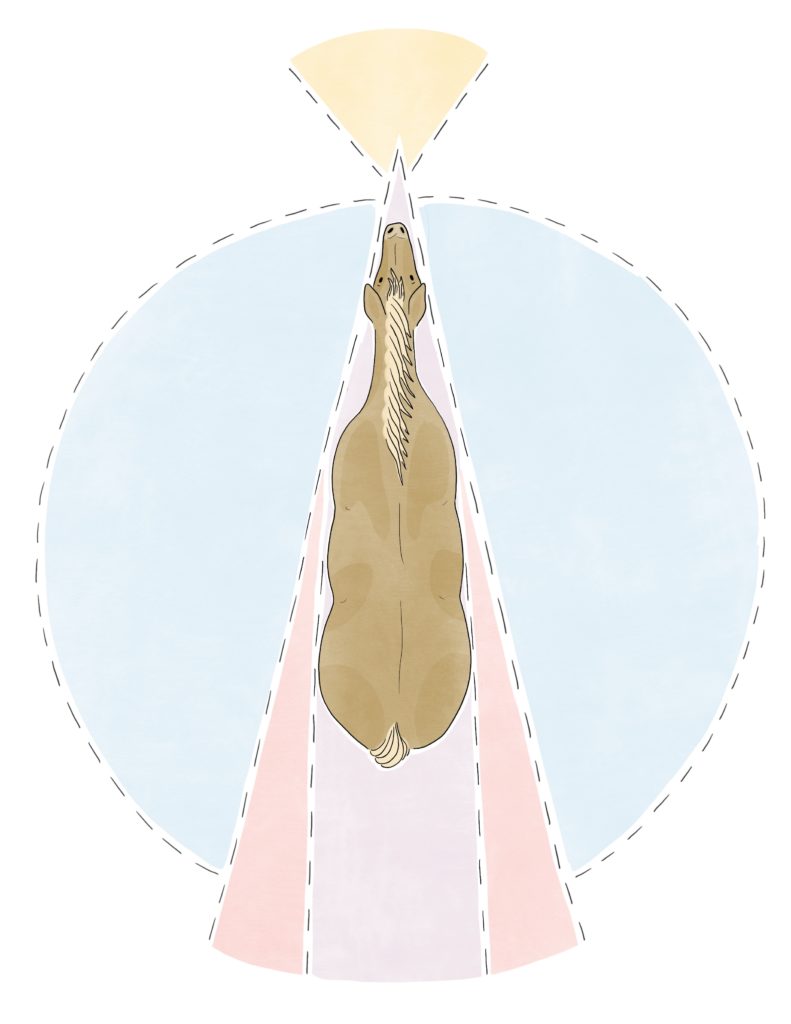
For a long time, humans believed that what a horse saw with one eye was not transferred to the opposite hemisphere of the brain. While they have a wide view, their binocular vision (where both eyes focus on the same object) and corresponding depth perception isn’t as strong as our own. That being said, their depth perception is much better than originally thought and their frontal vision is thought to be 20/30 to our own 20/20 vision. Researchers noticed that their depth perception abilities coincide with the depth between blades of grass and the ground they are growing from! Horses have also clearly demonstrated their ability to use environmental cues to ascertain the distance between objects. One study provided evidence of this ability even in photographs! While their depth perception is decent, equines their ability to detect movement is superb! This ability helps keep them safe from predators.
A Course In Color
While equines may not see colors as richly as most humans do, they can still distinguish between colors. Reds, in particular, may appear closer to various shades of grey or dull and faded. Studies have shown that contrast is an important aspect to consider as well. If you would like to provide a visual cue for equines, avoid reds, oranges, and shades along this spectrum. Ensure the background color is significantly different from the signal you place as the marker. In the study mentioned, researchers found white, fluorescent yellow, and blue served as a better marker than orange on a guardrail in a mostly green and brown environment. Consider how neon yellow, a typically highly visible, may be somewhat less visible against bright spring foliage. If the background is sky then light blues and white wouldn’t provide much of a contrast and wouldn’t be as noticeable to the resident.
Light And Dark
While our depth perception is sharper than equines, they certainly have us beat in terms of night vision! In fact, equines can see well in low-light conditions and in bright daylight. The tapetum lucidum is the structure responsible for their night vision abilities, as mentioned above. However, the transition from light to dark takes around 20 minutes to full acclimate. Remember this when guiding residents from bright to low light spaces. They may be hesitant or just not generally able to see as well for a bit which can make some individuals nervous. In addition to these cool night vision abilities, equines also have the corpora nigra (iridic granules) that act as a sort of sun filter in bright daylight. You can think of this like a sun visor or lifting your hands a bit to cover the sun so you can see better.
When Sight Fades: Eye Conditions Equines
As with humans, equine vision can be compromised by age, illness, or injury. Eye conditions are fairly common, and understanding what aspects of the eye to monitor is important. Some of the most common conditions include:
- Corneal Injuries/Disease: Corneal disease can include ulcers (dealing with the topmost layer of the cornea), abscesses (deeper infections), and immune-mediated keratitis (caused by the immune system capable of affecting different layers of the cornea). Signs may include squinting, watery eyes, cloudiness, redness. An equine’s large, prominent eyes make them susceptible to corneal injuries.
- UveitisUveitis is a form of eye inflammation. It affects the middle layer of tissue in the eye wall (uvea) : Uveitis is inflammation of the uveal tract and can cause discomfort, pain, sensitivity to light, watery eyes, redness, and a cloudy or blue appearance of the eye. Equine recurrent uveitis is the leading cause of blindness in equines. Any signs should be immediately checked and treated.
- Squamous Cell Carcinoma: This is the most common type of eye cancer seen in equids. It can occur in the eye and on the eyelids. These tumors or lesions usually affect one eye but can affect both. It can spread to adjacent tissue and cause serious damage to the eye, even totally destroying it. Early detection is key. Horses who lack pigment around the eyes are at a higher risk of developing squamous cell carcinoma on the eyelids. There is also a genetic predisposition for developing SSC of the eye in certain breeds such as Halflingers, Rocky Mountain Horses, Holsteiners, Belgian Warmbloods, Belgians, and Connemara Ponies.
- Corpora Nigra Cysts – Cysts of the corpora nigra are usually benign dark sacs or “bubbles” that may obscure the pupil.
- Cataracts: Cataracts are common. While the cause isn’t always known, they may have a hereditary component or be caused secondarily to inflammation in the eye from injury or diseases.
- Age-Related Changes: Like many beings, older equines may lose some of their sight, affecting how they navigate their space and interact with their social group.
Also of importance is the ability of many equines to adapt to a slow deterioration of visual acuity. This can make it challenging to notice behavioral cues indicating blindness in some cases. Be sure to do routine eye health checks for injuries or changes so they can receive treatment swiftly or you can adjust their care plan accordingly, when appropriate. While some individuals may show little Below are some signs that could indicate loss of vision:
- Change in personality: more fearful, nervous, excitable, confused, reactive etc… Remember, you know them best. If someone doesn’t seem to be themselves, make sure to check them out.
- Change in behaviors: less active/standing, reluctance to being haltered and led, easily startled, walking with a high-stepped gaitA specific way of moving and the rhythmic patterns of hooves and legs. Gaits are natural (walking, trotting, galloping) or acquired meaning humans have had a hand in changing their gaits for "sport". (because they don’t know where to put their hooves down), or bumping into others or objects.
- Change in social dynamics: while it may be challenging for us to notice small changes in an individual, their companions will notice and this can lead to changes in social relationships. Keep an eye out for confrontations and individuals being on their own or with another resident more than usual.
How Can Caregivers Support Equine Residents
Now that we have learned the basics of equine eye anatomy and abilities, we can apply this knowledge to caregiving practices. Understanding how equines see the world isn’t just interesting—it’s practical. Here are some ways caregivers can use this information to enhance resident well-being:
- Avoid Startling Approaches: Move slowly and calmly. Talking in a low, gentle voice as you approach allows equines to locate you and helps prevent them from being startled—especially when you’re in their blind spot. Approach from an angle where they can see you clearly. Learn about flight zones here.
- Monitor Eye Health: Routine health checks are essential, but daily observation is just as important. Equines can adapt to partial blindness, especially if it happens slowly. Practicing your observational skills can help you catch early signs of eye problems or other health issues before they worsen.
- Design with Vision in Mind: Open, uncluttered areas help equines navigate confidently. While physical enrichment is important, residents with visual impairments need safe, predictable access to shelter, water, food, and enrichment. Avoid placing small objects low to the ground where they could become tripping hazards.
- Include Visual Enrichment: Equines rely heavily on vision, so visual enrichment can support their well-being. Hang a photo of a familiar friend or ensure visual access to herd-mates if a resident must be temporarily isolated. However, keep in mind their sensitivity to movement and their strong instinct to flee if they perceive a threat. Stick to stationary items unless you know the individual well and are working with them on habituating to moving objects such as flags waving in the wind or plastic bags that may fly into the air. Provide enrichment objects that are distinctly different colors and see if they have a preference.
- Consider the Individual: Every resident is unique. Observing and adapting care to each resident’s strengths, challenges, and preferences ensures that every individual feels supported and safe.
In Summary
Equine vision is a fascinating subject and can help caregivers adjust their own behaviors and create nuanced care plans for their residents. By striving to “see through their eyes,” we can deepen our connection with them and create care environments that feel safer and more intuitive. We hope you found this resource helpful! If you have questions or would like to share your experiences, please let us know. Up next in our sensory exploration: how equines experience the world through sound.
SOURCES
Lateral Vision In Horses: A Behavioral Investigation | Behavioural Processes (Non-Compassionate Source)
Interocular Transfer Of Learning In Horses (Equus Caballus) | Journal Of Equine Veterinary Science (Non-Compassionate Source)
Assessment Of Vision And Common Eye Problems In Horses | Cornell University College Of Veterinary Medicine (Non-Compassionate Source)
Ultrasonographic And Histopathologic Features Associated With Common Ocular Diseases In Donkeys (Equus Asinus) | Veterinary Research Communications (Non-Compassionate Source)
Ocular Squamous Cell Carcinoma | UC Davis Weill School Of Veterinary Medicine (Non-Compassionate Source)
Equine Vision | Veterinary Key
Let Us Have A Look…At Corpora Nigra | Dr Paula Williams BSc (Hons) BVSc MRCVS MANZCVS
Horse Vision And Obstacle Visibility In Horse Racing | Applied Animal Behavior Science (Non-Compassionate Source)
Horses Are Sensitive To Pictorial Depth Cues | Perception (Non-Compassionate Source)
Horse Vision Through Two Lenses: Tinbergen’s Four Questions And The Five Domains | Frontiers In Veterinary Science (Non-Compassionate Source)
Interocular Transfer Of Learning In Horses (Equus Caballus) | Journal Of Equine Veterinary Science (Non-Compassionate Source)
Characterization Of The Normal Dark Adaptation Curve Of The Horse | Veterinary Ophthalmology (Non-Compassionate Source)