



Seeing Through Their Eyes: Understanding Alpaca and Llama Vision to Improve Sanctuary Care
As caregivers it is important to deepen our understanding of how the residents we care for experience the world around them. Doing so allows us to connect better with our residents, providing thoughtful, individualized care. While it may seem best to assume they perceive the world similarly to us, as might be the case when we think how we would feel if someone were giving us a shot, there are many situations where that genuine expression of empathy may not accurately reflect the residents’ experience. Using our own experiences can still be a useful tool when balanced by a strong understanding of how different species experience the world through their senses. We evolved differently and our biologies can interact with the world around us in unique ways. So, while we all experience excitement, frustration, contentment, how we experience that can vary greatly between species.
For example, humans are said to have “20/20 vision,” yet many wear glasses. Llamas and alpacas, too, show individual differences in vision. Despite individual differences, all species have general traits that we can learn about and apply to our interactions and care decisions to connect and provide the best care for our residents.
This article is part of a five-part series exploring how llamas and alpacas experience the world through their senses. First up, how llamas and alpacas see the world around us, how that may differ from our own experience, and how this can direct the care we provide.
Ocular Insights: Camelid Vision and Care
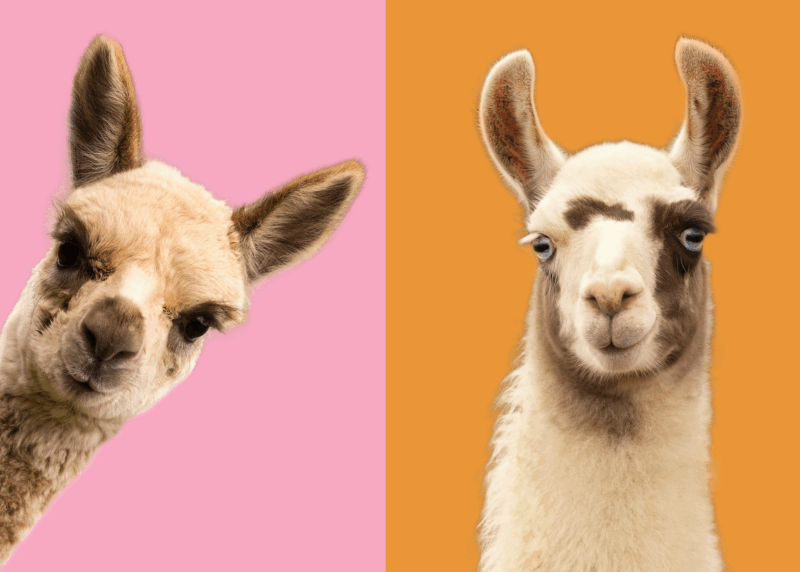
Look at those lashes! Alpacas and llamas have lovely, large, prominent eyes that give them a wide field of vision. These eyes are just for beauty though; that wide field of vision helps them stay alert to predators while grazing. Because alpaca and llama eyes are so prominent, they are prone to injury, making careful observation by caregivers essential to noticing subtle changes in eye health. Before we go further into visual abilities, let’s take a look at the anatomy structures of their eyes and how those structures work.
A Peek Inside: Alpaca And Llama Eye Anatomy
Those soulful eyes contain familiar structures to our own, such as pupils, lenses, and retinas. Yet there are important differences that shape how alpacas and llamas experience their surroundings. Namely, their pupils are horizontal ovals, their eyes are significantly larger than ours, and they have a special reflective layer that boosts night vision! Together, these features affect not just what they can see, but how they interpret what they’re seeing.
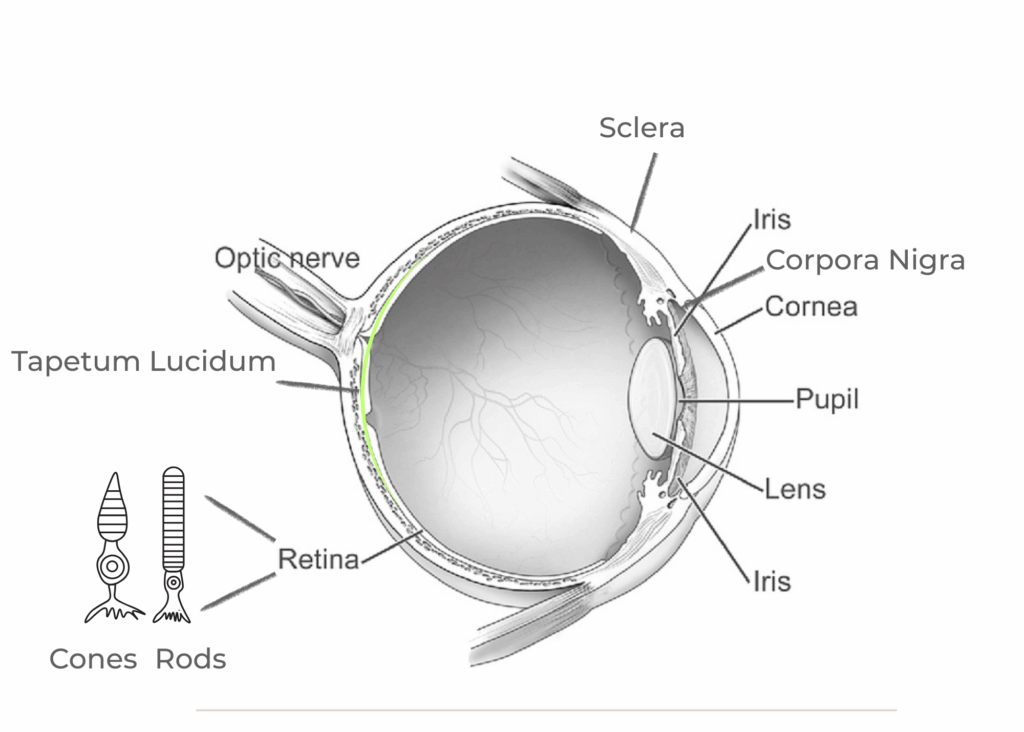
By looking at the major parts of a camelid’s eye, we can begin to understand what visual abilities that have Let’s break down some of the basic parts of the eye and how they function in alpacas and llamas:
- Cornea: Cornea: The cornea is the clear, dome-shaped part of your eye. If you have contacts, it is the part you touch your contact lens to. It protects the eye and allows light to enter.
- Sclera: This is the white portion of the eye that provides the majority of the structure.
- Iris: The colored part of the eye—typically a shade of brown but can also be light grey/blue. Sometimes one eye may be blue and the other brown. The iris regulates how much light enters the eye and is part of the uveal tract, which supplies blood to parts of the eye.
- Pupil: The black, round opening in the center of the iris that controls how much light enters the eye by expanding in low light and contracting in bright light.
- Lens: The lens sits behind the iris, changing shape deepening on the distance of what the eye focuses on and focuses light onto the retina. It will thicken if the looker is viewing something close up and then if the object is far away. This shape-shifting is controlled by the ciliary muscles (not shown in basic diagrams).
- Retina: The inner lining at the back of the eye, containing millions of photoreceptors—light-sensitive cells known as cones and rods—that convert visual information into electrical signals. These signals are transmitted to the brain via the optic nerve.
- Cones: Cone cells are responsible for vision in bright light and for detecting color. Humans have three cones, making us trichromats (we see reds, greens, and blues). With two cones, camelids are dichromats—they see blues and yellows more readily, while reds and greens may blur together.
- Rods: Rod cells help with vision in low light.
- Tapetum Lucidum: A layer of light green tissue behind the retina that reflects light back through it, allowing camelids to see better in the dark. (We lack this structure—when you see glowing eyes in the dark, this is due to the tapetum lucidum.)
- Corpora Nigra: Also called “iridic granules,” these ruffle-shaped structures atop the pupil reduce glare from bright sunlight. Alpacas and llamas have especially prominent iridic granules.
While alpacas and llamas share similar eye structures with other mammals, they have an epithelium about 30% thicker than that of many species. This is believed to provide additional protection from ultraviolet light as well as from dehydration and trauma.
Now that we’ve learned about a alpaca and llama basic eye structures and their purposes, let’s jump into the world of camelid vision!
A Wide View, Limited Depth
Once we understand the parts of the eye, we can better learn how our alpaca and llama residents “view” the world. With eyes on the sides of their heads, camelids rely mostly on monocular vision—each eye sees a slightly different slice of the world. Their binocular overlap (where both eyes focus on the same object) is only about 20–50 degrees, so depth perception isn’t their strong suit. Their horizontal pupils and reflective tapetum lucidum enhance their low-light vision, allowing them to see well at dawn, dusk, and in shaded areas.
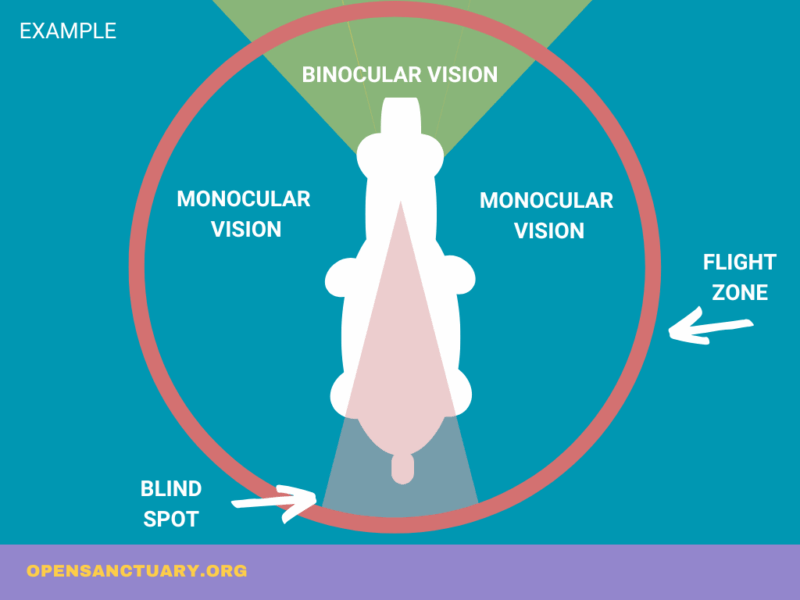
Eye placement also results in a limited vertical field of view. While we can look straight out and see both the sky and the ground, camelids can’t. This is why they often lower their heads—to check the ground.
Still, one of the most remarkable aspects of alpaca and llama vision is just how much of the world they can see at once. Their monocular vision gives them an impressive field of view—nearly 330 degrees compared to our 180! This wide view allows them to scan their environment for potential threats almost constantly, making it challenging for predators to sneak up on them. his is really quite incredible and so different from our own experience.
Alpacas and llamas are also keenly attuned to movement. Have you ever lifted a bucket from ten feet away and had a resident startle? That may be because they often perceive motion as a series of jerky steps—not smooth transitions like we see.
While alpacas and llamas may not see colors as richly as most humans do, they can still distinguish between colors, as can be seen in this video. (This can be a fun cognitive, social, and sensory enrichment activity to try with your camelid residents!)
Alpacas and llamas are also keenly attuned to movement. Their impressive monocular vision helps them stay alert to any environmental changes or potential threats. Keep this in mind as you move about sanctuary spaces.
Recognizing Faces—and Problem-Solving
Vision doesn’t just help alpacas and llamas navigate their environment—it also plays a role in their social lives. Camelids can recognize familiar faces, especially those of their herd-mates. While that may not seem surprising, studies show that alpacas and llamas can learn through social learning—by watching other herd-mates perform actions. They can also learn by observing humans.
For example, a llama resident named Tank may figure out how to lift a gate latch just by watching you! (Make sure those latches are secure.)
When Sight Fades: Eye Conditions in Alpacas and Llamas
As with humans, alpaca and llama vision can be compromised by age, illness, or injury. Eye conditions are not uncommon, and awareness helps caregivers know what to keep and eye out for.
Some of the most common conditions include:
- Cataracts: Cataracts cause an obstruction to vision, generally resulting in partial to total blindness. They appear as a cloudy lens and can develop due to an injury or through hereditary means.
- Corneal Ulcers/Injuries: Due to their large, prominent eyes, alpacas and llamas can incur injuries easily. Eye injuries can occur from something as simple and being poked in the eye by a strong, stray piece of straw so it is important to practice good observation skills to detect any issues early and treat quickly prevent serious complications.
- Age-Related Changes: Older residents may experience vision loss, though many can still see quite well. The loss of sight can significantly affect a residents ability to safely maneuver through their environment, find new resources, and respond appropriately to social cues from herd-mates. Be sure to pay close attention to your older residents, watching for any changes that might indicate worsening vision.
How Can Caregivers Support Alpaca and Llama Vision?
Hopefully, you can now “see” how understanding how residents perceive the world through their senses is an important part of developing best care practices. This knowledge can improve how you plant enrichment, health checks, and simply how you engage with your residents day to day. Let’s go how the information provided in this resource can be applied in a sanctuary environment.
Avoid Startling Approaches: Alpacas and llamas have a blind spot directly behind them. Be sure to keep their field of vision in mind and remember that sudden movements can be particularly startling. Move slowly, speak in a low, gentle voice, and approach where they can see you.
Monitor Eye Health: Routine health checks plus daily observation help identify issues early on and improve chances of recovery.
Living SpaceThe indoor or outdoor area where an animal resident lives, eats, and rests. Design: For those with visual impairments, it is important to have an open living space, free of “clutter”. Avoid low-lying objects that may become tripping hazards. You can still provide interesting physical enrichment, just be sure the resident knows where it is at and don’t move things around for novelty’s sake. Food and water and shelter must be easily accessible without obstacles.
Include Visual Enrichment: For residents with healthy vision, provide interesting opportunities for them to use their eyes. Pinwheels outside their area, balls or buckets with distinctive colors, rearranging and adding new elements to their living area. This also overlaps with social enrichment. Llamas and alpacas should be within eyesight of each other if they must be separated for a time. Hanging pictures of their friends or a mirror when they are in isolationIn medical and health-related circumstances, isolation represents the act or policy of separating an individual with a contagious health condition from other residents in order to prevent the spread of disease. In non-medical circumstances, isolation represents the act of preventing an individual from being near their companions due to forced separation. Forcibly isolating an individual to live alone and apart from their companions can result in boredom, loneliness, anxiety, and distress. can also be beneficial.
Consider the Individual: As always, consider the individual. Each resident has their own unique experiences, preferences, and health status.
In Summary
While there are some commonalities, your llama and alpaca residents experience the world differently from humans in many ways. Notably their wide field of vision, limited ability to judge distance, and their high sensitivity to movement. Sight affects their every day lives and how the navigate living spaces and social interactions. By striving to “see through their eyes,” caregivers can deepen our understanding of their experience, building trust, and creating best care practices.
We hope you found this resource helpful! If you have questions or want to share experiences, please reach out. Up next in our sensory exploration: how llamas and alpacas experience the world through sound.
SOURCES
Behavioural Biology Of South American Domestic alpacas and llamass: An Overview From A Welfare Perspective | Small Ruminant Research (Non-Compassionate Source)
Ophthalmology of South American Camelids | Veterinary Clinics of North America: Food Animal Practice (Non-Compassionate Source)
Diagnostic Ophthalmology |The Canadian Veterinary Journal (Non-Compassionate Source)
Ophthalmology of clinically normal alpacas (Vicugna pacos) in the United Kingdom: a cross-sectional study | Vet Record (Non-Compassionate Source)
Llamas Use Social Information From Conspecifics And Humans To Solve A Spatial Detour Task | Animal Cognition (Non-Compassionate Source)
The Response of LLamas (Lama Glama) to Familiar and Unfamiliar Humans | International Journal of Comparative Psychology (Non-Compassionate Source)