



As caregivers, it is important to deepen our understanding of how residents experience the world around them. Doing so allows us to connect more effectively and provide thoughtful, individualized care. While it may seem helpful to assume they perceive the world similarly to us, there are situations where that genuine expression of empathy may not accurately reflect the residents’ experience. Our own experiences can still be useful when balanced with an understanding of species-specific sensory differences. We evolved differently, and our biologies interact with the world in unique ways. So, while we know what it feels like to experience excitement, frustration, boredom, pain, and contentment, what contributes to these experiences can vary between species.
Variation is also found between individuals of the same species. Humans are said to have “20/20 vision,” yet many wear glasses. Sheep also show individual differences in vision. Despite these differences, all species have general traits that we can learn about and apply to our care decisions to better support residents.
This resource is part of a five-part series exploring how sheep experience the world through their senses. In this resource, we explore how sheep see the world around them, how that may differ from our own experience, and how this can inform care practices.
Understanding the basic eye structures is a helpful starting point when learning about their visual abilities. Let’s take a look!
A Peek Inside: Sheep Eye Anatomy
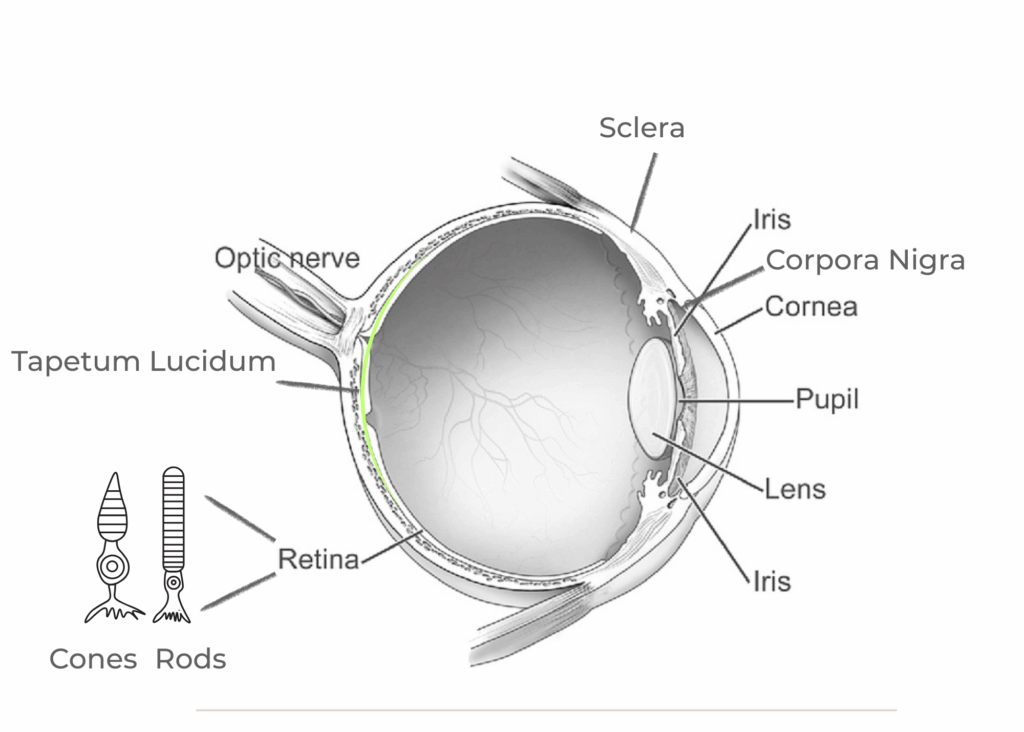
Like humans, sheep have familiar eye structures—pupils, lenses, and retinas—but with important differences that shape perception.
Cornea: The clear, dome-shaped part of the eye that protects it and allows light to enter.
Sclera: The white portion of the eye that provides most of its structure.
Iris: The colored part of the eye—typically brown or amber, and less commonly blue—that regulates how much light enters.
Pupil: The horizontal opening in the center of the iris that expands in low light and contracts in bright light.
Lens: Located behind the iris, the lens changes shape depending on distance to focus light onto the retina. It thickens for close objects and thins for distant ones.
Retina: The inner lining at the back of the eye containing photoreceptors (cones and rods) that convert light into signals sent to the brain.
Cones: Responsible for color vision in bright light. Sheep are dichromats, meaning they more readily perceive blues and yellows, while reds and greens may blur together.
Rods: Support vision in low-light conditions.
Tapetum Lucidum: A reflective layer behind the retina that improves night vision.
Corpora Nigra: Structures above the pupil that help reduce glare from bright sunlight.
Ocular Insights: Sheep Vision
While sheep eyes share some anatomical similarities with human eyes, their structure and function reflect the unique challenges of evolving as a ruminant prey species. Sheep rely heavily on vision to detect threats and navigate their surroundings. Sight also shapes their social interactions. While sheep have fairly clear vision, they aren’t able to focus the lens to sharpen an image at a distance like we can. Goats, on the other hand, share this ability with us. By understanding the visual capabilities and limitations of our residents, caregivers can create safer, more enriching environments that support resident well-being.
So what are important characteristics of sheep vision that caregivers should know about? This isn’t an exhaustive list but it will help you gain a deeper understanding that we hope will assist you in your care routines.
- Wide field of vision
- Poor depth perception
- The ability to see somewhat better than humans in low light conditions
- The ability to recognize facial details–and remember them
- Dichromatic vision- with limited evidence that ewes may see reds, oranges, and yellows as significantly different, if not how we perceive them. Dichromatic vision may also enhance motion detection abilities
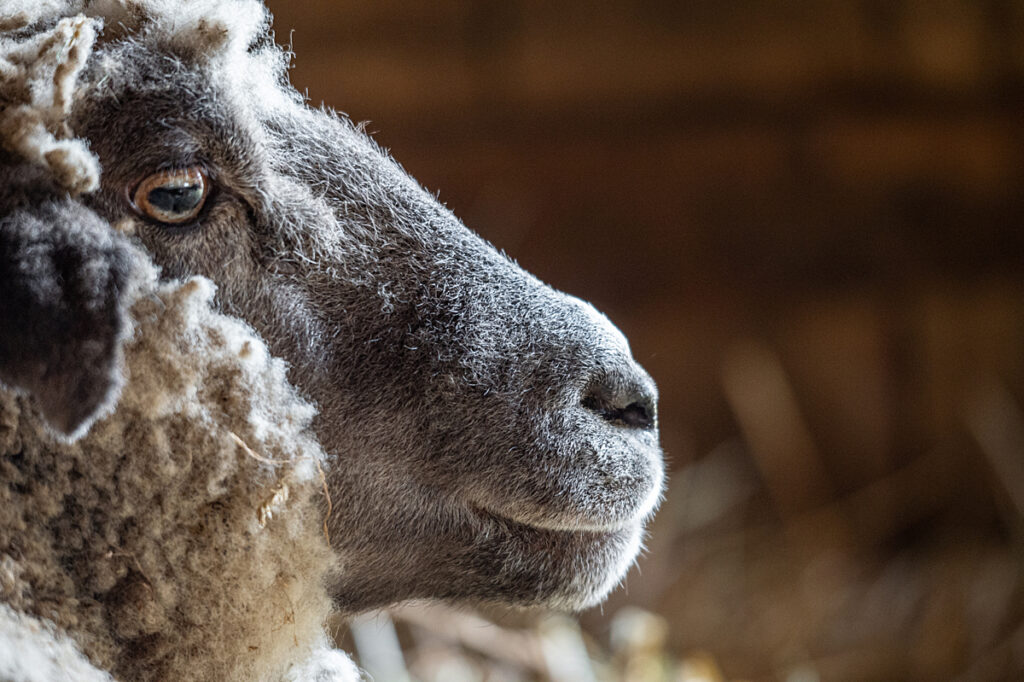
- Some sheep have wooly faces that, when left unsheared, can limit their vision.
- Limited ability to sharpen their focus on distant objects
- Eyes that move independently and horizontal pupils that stay horizontal to the ground while grazing and looking down.
Lets take a closer look at their field of vision and facial recognition abilities.
A Wide View, Limited Depth
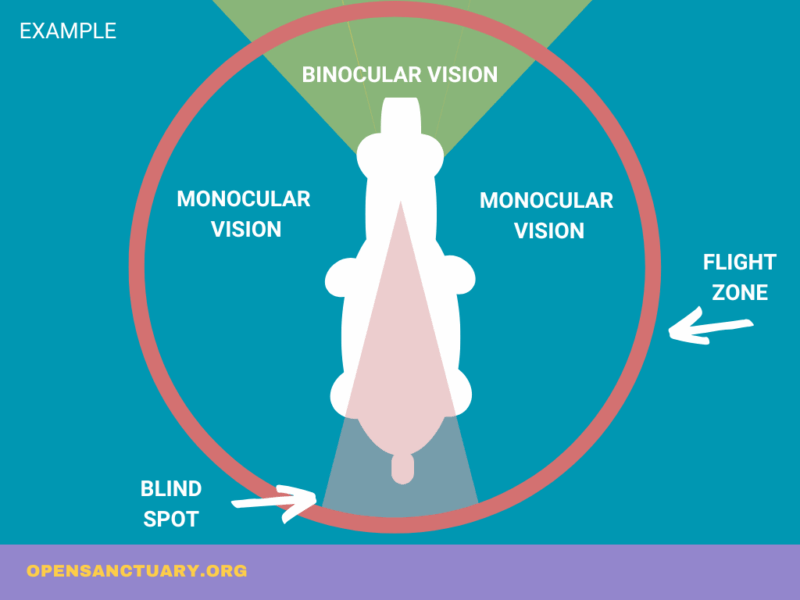
As prey animals, sheep benefit from having eyes on the sides of their heads, which allows for a wide field of view. This monocular vision makes up most of what they see. A smaller portion (about 30–40 degrees) is binocular vision, where both eyes focus on the same area. Altogether, sheep have a field of view of approximately 300°, compared to about 180° in humans.
However, this wide field of view comes at a cost. Depth perception is limited, making it difficult to judge distances or interpret shadows. Wool growth around the face can further restrict vision and is important to keep in mind, as well. This trade-off supports strong movement detection but reduces visual acuity.
Impressive Facial Recognition Abilities
Sheep also rely on vision for social recognition. They can identify familiar and unfamiliar sheep and humans. Studies have found that sheep can even distinguish between human faces in photographs, including those of celebrities, across different angles.
When Sight Fades: Eye Conditions in Sheep
Just like us all, a sheep resident’s vision can be affected by injuries, illnesses, or decline with age. Learning about the issues common to sheep is helpful, allowing you as their caregiverSomeone who provides daily care, specifically for animal residents at an animal sanctuary, shelter, or rescue., to detect issues earlier. A few of the conditions caregivers should be aware of include:
- Entropion: This is a condition where the lower eyelids roll inward towards the eye and can cause serious irritation and even damage to the cornea. Its considered a hereditary condition that generally affects lambs but adults may also be affected.
- Contagious KeratoconjunctivitisKeratoconjunctivitis is an infectious often epidemic disease that is caused by an adenovirus (especially serotypes of species Human adenovirus B and Human adenovirus D of the genus Mastadenovirus) and is marked by pain, redness and swelling of the conjunctiva, edema of the tissues around the eye, and tenderness of the adjacent lymph nodes. (Pinkeye): If you you have been a farmed animalA species or specific breed of animal that is raised by humans for the use of their bodies or what comes from their bodies. sanctuary caregiver for awhile, you have likely run into this one. Pinkeye itself can refer to irritation and inflammation caused by a number of sources. However, contagious keratoconjuntivitis is caused by a bacteria and is highly contagious to herd-mates.
- Cataracts: Cataracts cause an obstruction to vision, generally resulting in partial to total blindness. They appear as a cloudy lens and can develop due to an injury or through hereditary means.
- Corneal Ulcers/Injuries: Eye injuries can occur from something as simple and being poked in the eye by a strong, stray piece of straw so it is important to practice good observation skills to detect any issues early and treat quickly prevent serious complications.
- Age-Related Changes: Older sheep may experience vision loss, though many can still see quite well. The loss of sight can significantly affect a resident’s ability to safely maneuver through their environment, find new resources, and respond appropriately to social cues from herd-mates. Be sure to pay close attention to your older residents, watching for any changes that might indicate worsening vision.
Supporting Sheep Vision in Sanctuary Care
Hopefully, you can now “see” how understanding how residents perceive the world through their senses is an important part of developing best care practices. This knowledge can improve how you plan enrichment, health checks, and simply how you engage with your residents day to day. Let’s look at how the information provided in this resource can be applied in a sanctuary environment.
Avoid Startling Approaches: Sheep have a blind spot behind them, so approach slowly and from a visible direction.
Monitor Eye Health: Regular observation and routine checks help identify concerns early.
Design With Vision in Mind: Keep spaces open and free of low obstacles that may pose tripping hazards.
Provide Visual Enrichment: Maintaining visual contact with herd mates, incorporating enrichment objects with distinct colors, or providing pictures of herd mates on walls when a resident is temporarily separated can support well-being.
Consider Lighting: Sheep may hesitate when moving between bright to dark areas due to their lack of depth perception and prey instincts. Adjusting light levels can make transitions easier.
Consider the Individual: Everyone is an individual. Adapt care based on each resident’s needs and preferences.
In Summary
Sheep have a unique sensory experience, different from our own. They are highly sensitive to movement and have a wide field of view, but they struggle with depth perception and can’t focus as sharply. Their vision differs from our own considerably making it vital for us to learn about and consider their visual abilities when planning care routines and our daily interactions with sheep residents. By considering how sheep see their environment, caregivers can foster trust and create spaces that feel safer and more predictable.
We hope you found this resource helpful. If you have questions or would like to share your experiences, please reach out. Next in this series: how sheep experience the world through sound.
SOURCES
Photopigment Basis For Dichromatic Color Vision In Cows, Goats, And Sheep (Non-Compassionate Source)
Horses and Sheep and their Amazing Eye Movements | University of California, Berkeley
Facial And Vocal Discrimination In Sheep | Animal Behaviour (Non-Compassionate Source)
Discrimination Of Colours And Grey Shades By Merino Ewes: Tests Using Coloured Lambs (Non-Compassionate Source)
The Eye Of The Domesticated Sheep With Implications For Vision | Animal Science (Non-Compassionate Source)
Perception Of Environment In Farm Animals – A Review | Annuls Of Animal Science (Non-Compassionate Source)
The Effect Of Waterer Color And Frequency Of Waterer Cleaning On Sheep Water Intake | Hailey Jermolowicz Department of Animal SciencesThe Ohio State University (Non-Compassionate Source)
Sheep Recognize Familiar And Unfamiliar Human Faces From Two-Dimensional Images | The Royal Society Of Open Science (Non-Compassionate Source)
Intelligence, Complexity, And Individuality In Sheep | Animal Sentience
Eye Diseases in Sheep | NADIS Animal Health Skills
Ocular Conditions in Sheep and Goats | Veterinary Vision Center