




Episode Notes
Senior Advisor Tara and NonprofitA non-governmental organization whose primary purpose is something other than selling goods or services. Specialist Julia discuss how to take steps to prevent, recognize, and address foreign body ingestion by sanctuary residents. While every resident can be at risk of doing this, the degree of risk can vary, and there are action steps you can take to prevent it!
—
This Episode’s Referenced Open Sanctuary Project Resources:
- Don’t Eat That! Preventing Foreign Body Ingestion At Your Animal Sanctuary | The Open Sanctuary Project
- Advanced Topics In Resident Health: Heavy Metal Toxicosis In Birds | The Open Sanctuary Project
- Sharing Your Home With Chickens | The Open Sanctuary Project
Episode Transcript (Auto-Generated)
Julia Magnus: Welcome to the Open Sanctuary Podcast. Accessible conversations with the staff of the Open Sanctuary Project for the humans of sanctuaries, rescues, and those looking to get more involved with helping animals. Hi sanctuary friends and family, and welcome back to the Open Sanctuary Podcast. I’m Julia, the Project Specialist, and I’m here today with my friend and colleague Tara, our Senior Adviser, to discuss a critical safety topic that can get overlooked in the hustle and bustle of sanctuary life: preventing foreign body ingestion. When we talk about keeping our residents healthy, we often focus on things like biosecurityMerck Veterinary Manual defines biosecurity as ”the implementation of measures that reduce the risk of the introduction and spread of disease agents [pathogens].” for infectious diseases, preventative care, proper nutrition, or routine veterinary care. But the risk of residents ingesting foreign bodies is a threat people need to be aware of and also take steps to prevent. Let’s start with the basics. When we say foreign bodies, what exactly are we talking about?
Tara Hess: So, what we’re talking about is basically any non-food item that an individual ingests. These are things like nails or screws, twine, plastic, bits of wood, jewelry, coins, their bedding, and sand. The list goes on and on and on and on.
Julia Magnus: So, we’re not just talking about man-made things here, correct?
Tara Hess: Correct. Man-made things can obviously cause a problem, but natural materials that aren’t food and aren’t things that a particular individual should be ingesting are considered foreign bodies as well if they do ingest them. So, this could be things like sand and stones, wood, animal bones, and stone fruit pits.
Julia Magnus: So, the term foreign body can then describe a huge number of things. Does every animal face the same risk?
Tara Hess: No. I do want to say that I think every individual is at some risk, like anyone could ingest a foreign body. But the degree of risk really varies depending on factors that are specific to the individual. That includes things like their species, sometimes their breed, their age, and even their physical or psychological health can impact their risk of this. For instance, if we look at chickens and turkeysUnless explicitly mentioned, we are referring to domesticated turkey breeds, not wild turkeys, who may have unique needs not covered by this resource., who they are, and their natural behaviors, they spend their days pecking and scratching at the ground. They naturally ingest insoluble gritSmall stones or sand swallowed by birds to help them digest food., which is like small rocks and pebbles, and this is important to help them break down food. That natural behavior of theirs to scratch in the dirt and potentially unearth things that are right there, and then to pick up those little bits of pebbles and things, can put them at risk of ingesting other small objects that they might find that have been dropped in their space or end up in their space. So things like nails if someone was doing construction, jewelry, staples, and things like that. We both know from experience that large breedDomesticated animal breeds that have been selectively bred by humans to grow as large as possible, as quickly as possible, to the detriment of their health. birds are especially enthusiastic eaters and are at higher risk of foreign body ingestions as a result.
Julia Magnus: Yeah, absolutely.
Tara Hess: I think it certainly applies to large breed turkeys as well as large breed chickens, but I think Cornish chickens are just the pinnacle of this behavior. I think anyone who’s lived with Cornish chickens knows that while everyone’s an individual, if we’re going to generalize here, it’s pretty freaking common that if you’re with them and you drop something that could be food-sized, they’re going to come running, and if they get to it, they might eat it like it’s a piece of food. This behavior can really put them at risk. I can’t remember if I’ve told this story before on the podcast, but we took in at the sanctuary I worked with a Cornish chicken named Lucille who had been living in an apartment. We thought it would be a great idea for her to live in the caregiverSomeone who provides daily care, specifically for animal residents at an animal sanctuary, shelter, or rescue. office because she was used to being a house chicken. We actually had a house rooster who needed a companion because his partner had passed away. Lucille was hilarious. She would get up on the desk and she would go all over the place. She was everywhere all the time. At first, it just seemed so cute and adorable. She literally called me. The phone in the room she lived in had programmed extensions where you just have to hit one button to call someone. I would be in the office and see that the kitchen is calling me, and I would pick up and it would be Lucille. We would just laugh about this, except for one day when the risk of foreign body ingestion wasn’t even on our radar. We had had Mrs. Meyers, a Cornish who was the rooster’s previous partner, and we had never had an issue. But the difference was Mrs. Meyers was old, arthritic, and disabled. She wasn’t jumping up on the desk and calling all her friends; she was very much groundbound, whereas Lucille was all over the place. One day, Lucille didn’t want to eat. Anyone who cares for Cornish chickens knows that is a huge red flag that something is wrong. Whoever was feeding her checked her cropA crop is a pouched enlargement of the esophagus of many birds that serves as a receptacle for food and for its preliminary maceration., which is a great first thing to do, and they realized she needed to go to the vet. What they were feeling in her crop was so clearly not food. Thankfully, this story has a happy ending where Lucille ended up being fine, but I’m sure we had an expensive vet bill as a result. She came home with a Ziploc bag of all the things that they had taken out of her crop. There was 57 cents in change, a thumbtack, magnets, paper clips, and other office supplies. She had just had an office supply buffet. It was awful to think that no one ever saw her do it and no one ever thought that she was doing it. Now I can’t look at a situation like that without thinking she’s eating all the office supplies. They are definitely at a higher risk because they’re just always on the search for food.
Julia Magnus: I will say that this kind of thing isn’t totally restricted just to large breed birds because one of my team members rescued the teeny tiniest little hen ever, Aelia. She was also showing she was not really eating and looked a little off. When she was seen by our vet after rescue, it was determined she had swallowed a shockingly large piece of metal. I’m talking like the size of the top of a screwdriver in this tiny little hen, and it had to be surgically removed. She survived and is now living very happily at Little Blue Stem Sanctuary, but that was scary. I’m pretty sure that this kind of behavior and this issue is not limited to just birds either. So, what about the mammals?
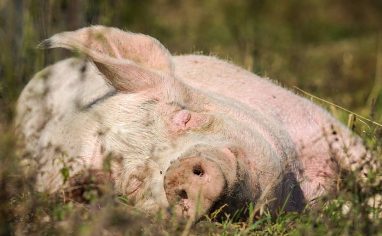
Tara Hess: Yeah, definitely not a large breed bird thing, and not just a bird thing. Mammals can also have issues. While anyone could in the right circumstances ingest a foreign body, certain species are just going to be at a higher risk. One species that comes to mind is pigs. Just like chickens and turkeys scratch at the dirt and might get surface-level things, pigs root in the ground. If you’ve ever seen what pigs do to the ground, they turn up the earth and can unearth things that other farmed animalA species or specific breed of animal that is raised by humans for the use of their bodies or what comes from their bodies. species in that same pasture would never be exposed to. It can be a situation where they tear up the pasture and find garbage, which is not uncommon depending on where you are. Buried or lost garbage can be unearthed. That can put them at risk because they’re accessing things that otherwise wouldn’t be accessed, and they do it so quickly that you might not notice. I’ve seen a little piece of twine where you pull and pull and it’s a huge thing. They just unearth it all at once and could potentially eat it. Also, as opportunistic omnivores, it’s not unnatural for them to ingest part of a wild animal who has died in their pasture. Eating animal bones is not good for pigs and it really puts them at risk.
Julia Magnus: And we can’t forget about our friends the goats either, can we?
Tara Hess: Yes, goats. Goats are notorious for getting into trouble in so many ways, but this is one that can really affect them to a greater extent as well. As browsers who stand up on their hind legs and are climbers, they can reach things that other residents can’t. Whether it’s stuff in their living spaceThe indoor or outdoor area where an animal resident lives, eats, and rests., which hopefully you’re managing well, or things that you’re bringing in, they are at risk. If you have exam gloves hanging out of your pocket or a stash of twine, they could easily get those things. I was in the sheep barn, which also housed some goats, and we had a healthcare kit in one of those coolers with a button that slides the top open. It was breaking, so sometimes you could push it open without the button. While we were doing a treatment, the goats swarmed the kit and one of them got it open. I looked over and one of the goats was quickly chewing a Ziploc bag that had eye drops in it. We had to stop everything, close the kit, and try to pull it out of her mouth without getting a finger sliced off by her incredibly sharp molars. It happens in the blink of an eye. They’re much more likely to do it than your average sheep. For some species, you have to be a bit more vigilant.
Julia Magnus: So how about cowsWhile "cows" can be defined to refer exclusively to female cattle, at The Open Sanctuary Project we refer to domesticated cattle of all ages and sexes as "cows."? I was a little bit surprised to see cows as someone we should be worried about.
Tara Hess: Cows are exposed differently. They’re not necessarily seeking these things out the way a Cornish chicken, a pig, or a goat might. But if you look at their eating behaviors, they take really big mouthfuls of food and they don’t chew it completely the first time around. If there happens to be something in that giant mouthful, they could very easily ingest it. This can happen in pasture, like the horror stories of a Mylar balloon floating into a pasture and someone eating it with the grass. But it’s a really big problem with hay. Sometimes in a bale of hay, you’ll find various things like twine left behind. Caregivers should be really careful about that, but sometimes there’s stuff actually in the hay. If you’re not shaking it all out, which you’re often not when feeding a bale, there could be a water bottle in there. We had a cowWhile "cow" can be defined to refer exclusively to female cattle, at The Open Sanctuary Project we refer to domesticated cattle of all ages and sexes as "cows." who stopped eating one day and went to the vet. Through imaging, they saw he had ingested a whole net that they suspected had been there for a while. It wasn’t something from the sanctuary grounds; he likely ingested it because it was mixed in with other things he was eating.
Julia Magnus: Makes sense. You also mentioned that age and health can be factors in this.
Tara Hess: For age, it depends on the species. With some, the risk is always there, while for others it varies, typically with younger individuals being more likely to be affected. Horses are a good example, as foreign body ingestion tends to be more common in foals. From a health perspective, things like nutritional deficiencies or psychological distress from inappropriate living spaces or lack of food access can put an individual at greater risk. It’s not uncommon for sanctuaries to take in a new resident who was previously starved or faced uncertainty around their next source of food. Some of those individuals may resort to eating non-food items. Once this behavior is established, it could continue even after they have a consistent, appropriate diet at the sanctuary.
Julia Magnus: That makes sense. Now that we’ve talked about the risks, let’s talk about some of the consequences. What happens if somebody ingests a foreign body?
Tara Hess: It’s going to depend on what they ate, where it’s located in the gastrointestinal tract, and how long it’s been there. Generally speaking, foreign body ingestion can cause really serious issues. If the object is too large to pass, it can result in a partial or complete obstruction, which can be life-threatening. It can also cause damage to the intestinal tract. People aren’t surprised to hear that pointy or sharp objects are dangerous and could perforate the GI tract, but it’s not just those objects that cause that.
Julia Magnus: You’re talking about linear foreign bodies. I think that might be surprising to some folks. Can you talk a little bit more about that?
Tara Hess: Linear foreign bodies are things like string, baling twine, or any other long, thin material. They can cause serious issues despite not being hard or sharp. Because one end can become stuck in the GI tract while the other moves along, the intestines can bunch up as they try to move it. This creates a sawing motion between the intestines and the foreign body, which can cause damage to the mucosal lining and ultimately perforation.
Julia Magnus: Eek.
Tara Hess: This is a big thing with cats.
Julia Magnus: Yeah, but I’ve also seen a duckUnless explicitly mentioned, we are referring to domesticated duck breeds, not wild ducks, who may have unique needs not covered by this resource. with a piece of twine hanging out. We had to get one person to drive and one person to hold the duck and the end of the string. I think you’re really not supposed to pull it out?
Tara Hess: Yeah, don’t pull it out.
Julia Magnus: There is also another risk from foreign body ingestion, which is toxicity.
Tara Hess: Yeah, and that really depends on what the foreign body is made of. Toxicity can certainly be an issue, especially items containing heavy metals like zinc or lead, which is a common cause of toxicity in birds. We have a whole resource on heavy metal toxicity in birds that we can link in the show notes.
Julia Magnus: That’s a really big deal. I’ve worked with multiple birds who’ve had heavy metal toxicity, including my cockatoo friend Murphy, who had to go through multiple rounds of chelation. Parrots are very delicate and put their mouths on everything, so definitely check out that resource. Next, if a caregiver suspects foreign body ingestion, what signs should they be on the lookout for?
Tara Hess: It really depends on the species, what they ingested, and where it’s located. Signs can include things like pain, inappetence, vomiting, regurgitation, abnormal feces, or a decrease or absence in feces. In birds, you might also notice crop distension. These signs aren’t specific to foreign body ingestion, so if you see them, always call your vet. My best advice is if you suspect foreign body ingestion, don’t wait for signs. Call your vet immediately to discuss next steps. It’s not necessarily a rush to the vet; having a conversation allows for less invasive treatment or guidance on whether treatment is even necessary. If it’s something like lead or zinc, your vet might say to bring them in for diagnostics immediately. If it’s a bit of plastic that isn’t sharp, they might suggest “poop patrol,” where you sift through their feces to see if the object passes. The sooner your vet can intervene, the better it is for everyone.
Julia Magnus: That makes a ton of sense. How do we prevent this in the first place? Do you want to break down some sanctuary-wide strategies?
Tara Hess: You can be so vigilant and things still happen, but the more you can reduce risk, the better. I would look at it from three points: living spaces, food sources, and things humans bring into the space. This isn’t a blanket set of rules for everybody because different individuals are likely to consume different things. Think about specific individuals. For example, a crushed water bottle in a bale of hay could be taken in by a cow, but a chicken isn’t going to eat a whole water bottle. Goats can reach things that chickens, turkeys, or sheep can’t.
Julia Magnus: You mentioned preventing foreign body ingestion in their living space, which includes storing concerning objects outside and checking for broken things like the cooler. Can you talk more about the risk during repairs?
Tara Hess: Repairs are one of the most high-risk times because of the nature of construction and maintenance. I recommend restricting resident access to the area during projects. If you’re working indoors where there’s bedding, remove the bedding first so it’s easier to see dropped nails or screws. You could put a tarp down, but removing bedding is safer. Outdoors, mow tall patches of grass so you can see anything that is dropped. Regardless of where you’re working, use a magnet sweeper to check for metal bits before giving residents access again.
Julia Magnus: Food preparation seems like another area to be vigilant.
Tara Hess: When feeding hay or straw, always remove all baling material and check as much as possible for foreign bodies like crushed water bottles, balloons, or plastic bags. If you find a ton of garbage in your hay, consider looking for a new supplier. For produce, remove stickers, rubber bands, and twist ties. If you feed stone fruits, make sure you’re removing the pit.
Julia Magnus: You also mentioned things humans might bring into a resident space. Can you talk more on this?
Tara Hess: People bring things in that residents could ingest. If visitors have toys, they should leave them outside. But as caregivers, we need to bring in items like exam gloves. We once had a Ziploc bag of gloves that we thought was out of reach, but a goat stretched to her maximum length and grabbed it. She started gobbling them up even faster when she saw me coming. You have to be mindful of keeping things contained and ensuring someone is paying attention so residents aren’t reaching over gates. Goats definitely keep you on your toes.
Julia Magnus: Many folks have farmed animal companions living inside their homes, including both of us. Is the risk different there?
Tara Hess: Yes. In a home, there are things you need that aren’t good for them. I recommend giving them a designated space that is theirs and set up solely for what they need. This helps manage hazards like foreign body ingestion and traction. When they are out of that space, close supervision is really important. The average chicken living outside isn’t going to be exposed to office supplies the way a house chicken might. We have a written resource and a podcast on indoor chickens that goes deeper into these risks.
Julia Magnus: We just need to be aware of these things and do the best we can to prevent access.
Tara Hess: Exactly. It’s about knowing it’s a risk for anyone and taking practical steps to reduce it as much as possible.Julia Magnus: Thank you so much, Tara, for sharing these insights and stories with us today. To our listeners, stay vigilant and keep your residents safe. If you enjoy this podcast, consider becoming a friend of the Open Sanctuary Project by joining our friends program on our website with a donation of $10 or more. You’ll get a shout-out, a social media badge, and our eternal gratitude.
Tara Hess: Eternal gratitude, yes, for sure.
Julia Magnus: Thank you so much all, and we’ll see you in our next episode.